Treasure of the Sierra Mente
or
Secret Map to the Source of Attention
These are a series of simple exercises to locate the source of attention.
After trying the Clock Exercise you may be interested in better locating the
source of your attention.
This is a big thing. It could be said that all awakening including, if we
believe in such a thing, “supreme enlightenment” or “merging with reality” can
be considered as merely more accurately locating the source of our attention.
This is a moving target and the one term “source of our attention” means
different things to people at different stages of the path.
Although simple these exercises can be challenging. If they were not,
everyone would already be enlightened. Instead, everyone already believes they
know completely the source of their attention and where it is. It is their familiar
feeling of “I”. People are not even aware they have a feeling of being an “I”,
any more than they are usually aware of their breathing. Just as people can
learn to become aware of their breath and even to modify it, so they can become
aware of their feeling of “I” and learn to modify it in a healthy, healing way
leading to awakening.
These exercises approach awakening our awareness of our feeling of being “I”
through the sense of sight.
Exercise
1:
Look around you. You see things (if your eyes are open, which is recommended).
These things surround your body.
That was easy, wasn’t it?
Exercise
2:
Examine this photograph of a long hallway.
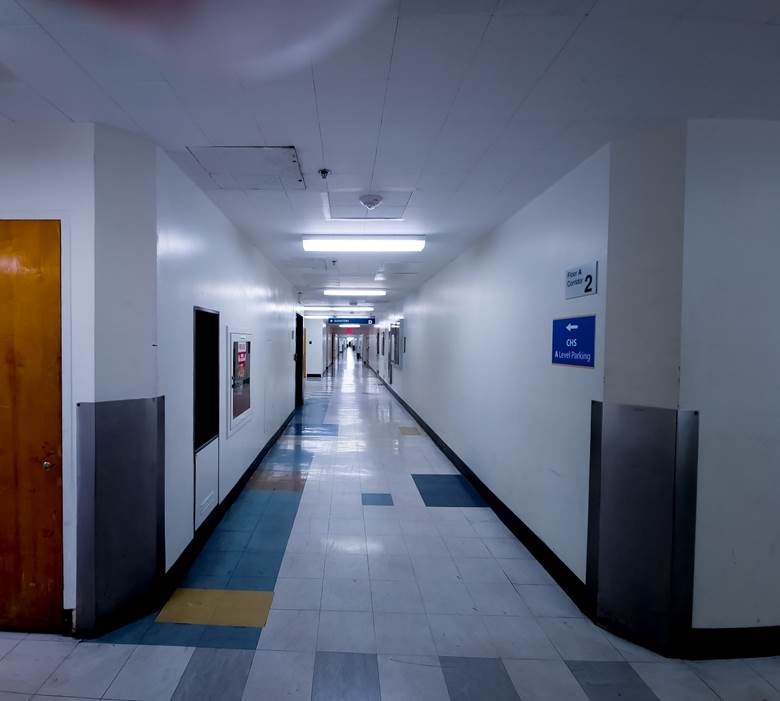
Notice how some objects seem far away and some seem close. In this case,
objects around the edge seem very close, and in the center seem very far. This
is a psychological effect of the visual centers In our brain that process the
image. We know in fact that this is a photograph and every object in it is at
the same distance, the distance of our eyes from our display device.
There are numerous perspective cues that our brain analyzes to report to our frontal
cortex how far each object is. Artists study these cues to paint flat pictures
that look three dimensional. When done very well, in the right type of
presentation, it can momentarily fool people into thinking it is real and not
just a painting. This is called “Trompe-l'œil” meaning fool the eye. It is a deception
or illusion of 3-D space.
Notice that you know exactly where you are in the illusory space of the
photograph. You are standing in the middle of an intersection of two hallways,
facing down one of them. The cues in the photo tell you your exact location, in
the imaginary space of the photograph, with respect to all the objects in the
photograph. For example, you are located about six feet away from the door on
the left, in the south-east direction if the center corridor is leading north.
In reality you are about two feet directly in front of the brown colored space
on the photograph that represents a door.
When you are clear about the four things to notice while looking at the photograph,
again look around yourself at the space you are in. Notice the perspective
cues like the ones in the photograph. Unlike the photography, you also now
have stereoscopic vision, The difference in location of your two eyes allow
your brain to compute distances to objects without any of those perspective cues.
This is a strong effect at up to 1.2 meters and helps a lot in distance
estimate by our brain up to 20 meters. You can remove stereoscopic cues by
closing one eye. Notice the difference in how the scene, the place where you
are, appears when you close one eye. The vivid three dimensionality disappears,
although you still know how far each object is from you.
Exercise
3:
Now hold your hand up in front of your face and point outward like this:
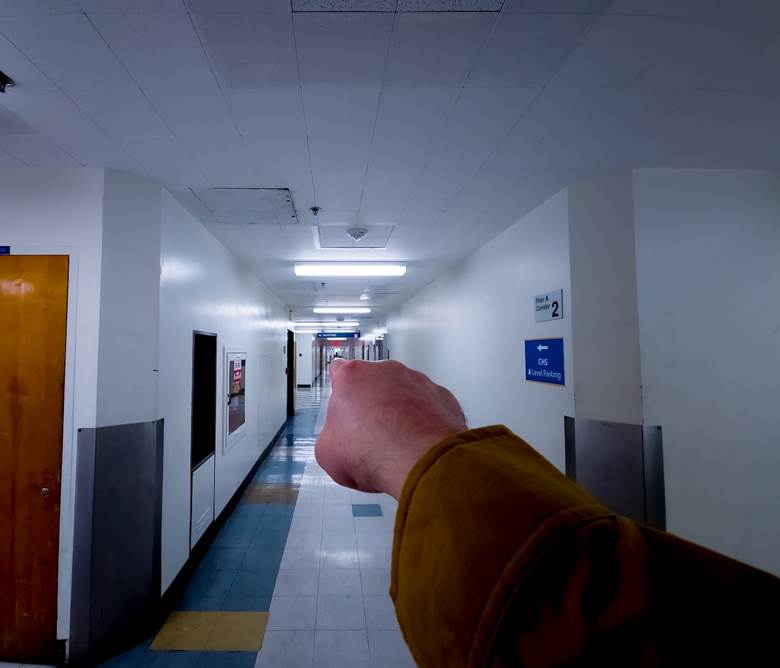
You are pointing away from yourself at distant end of the long corridor. You
can try pointing at different objects in your environment. When you direct
your gaze in those directions, you see the objects that have color, shape and
distance.
Exercise
4:
Now reverse your hand and point toward your face:
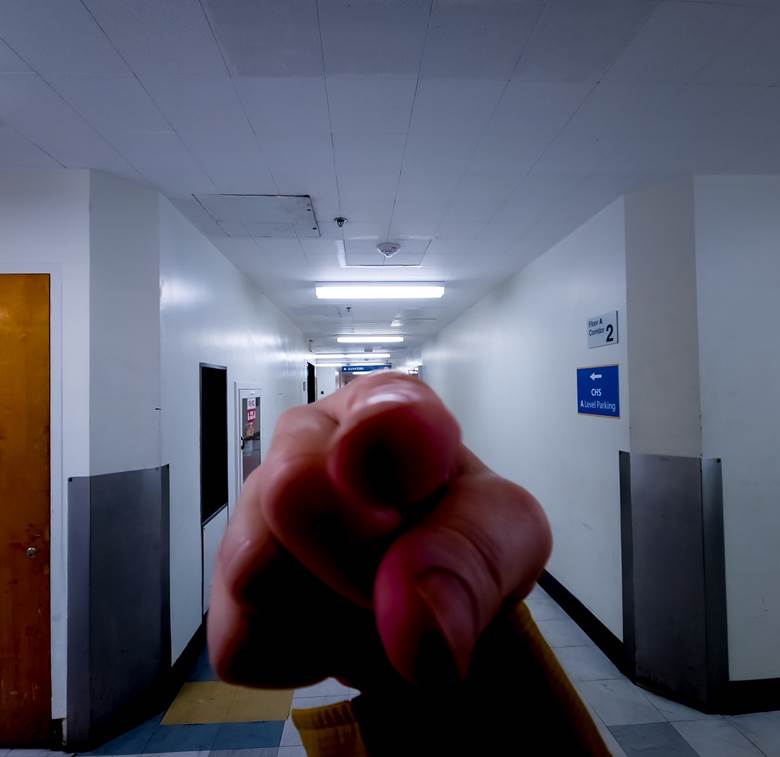
You are now pointing directly at the exact spot where the observer
appears to be located. You know you are pointing at your eyes. For the
purpose of this exercise though we want to stick to what appears to our vision,
without including our mental model of the world.
In our visual field the if we can direct our attention in the direction the
finger is pointing, we might find nothing there. There may appear to be a
space that dark or empty, with no colors or shapes. We appear to be located
there looking out at the world through our eyes.
It is not so easy to stop relying on our mental model of the world. As long we
do that our attention is not on our actual direct perceptions but on how they
are interpreted by our ideas about the world. Then the empty dark space is
replaced by an imaginary image of our head, as if we were looking at ourselves
from outside. We know our head is there. And it of course it is there. But
for this exercise, we want to examine strictly what is appearing from our
direct perception. This is called phenomenology in Western philosophy and
Vipassana meditation in Buddhism.
Phenomenologically we do not see our source of attention in this dark empty
space. It does not appear as having a color or a shape. It itself is invisible.
It is not only invisible- there is no perceptual data about it at all. We know
it is where the source of our attention is in the same way we know where we are
standing in the first photograph. All the visual cues tell us that is where
we, the observer, are located.
This mysterious empty space behind our eyes, if we find it, can be taken
provisionally as the source of our attention. If not, we can take our eyes or
our head as the source of our attention for the purpose of the Clock Exercise.